"We are all in the gutter, but some of us are looking at the stars" - O.W.

Current Study

Current Sub-Studies

Areas of Interest:
> literature, trauma, and ethics
> science fiction and alternate history
> 20th and 21st century literature
> capitalism and the anthropocene
> history and literature of science
> comics and graphic novels
> science communication

22 November 2010

A Little Woo Hoo

Had a little woo hoo moment recently.1 Whilst reading Caroline Wiedmer's examination of The Claims of Memory: Representations of the Holocaust in Contemporary Germany and France (which is so far excellent), I came across the first usage of the word "mimetic" in relation to Second World War historical fiction. This is significant because since choosing to define my study as being of non-mimetic fictions I've read lots of material which I'll certainly be able to use but none which  uses my terminology. Wiedmer's has hopefully broken the drought and I shall now be inundated with uses of mimetic, or better yet non-mimetic.

Better still, she uses it in relation to Art Spiegelman's Maus which I recently finished reading for the Graphic Novel book club I run and not only greatly enjoyed but also plan on using in my own study.

That's it really, not exactly a major breakthrough (hence not a Eureka! moment), but a brief moment when I looked up from my research and smiled a little as another piece of the jigsaw fell into place. Just thought I'd share that with you, as its been a bit dry in my blog-posting-world. Thanks.


1 Yes, having played The Sims I know that has a different connotation to the way I mean it - I don't care.

11 November 2010

'From Flaubert to the Fantastique: Science Fiction and the Literary Field' by Professor Andrew Milner

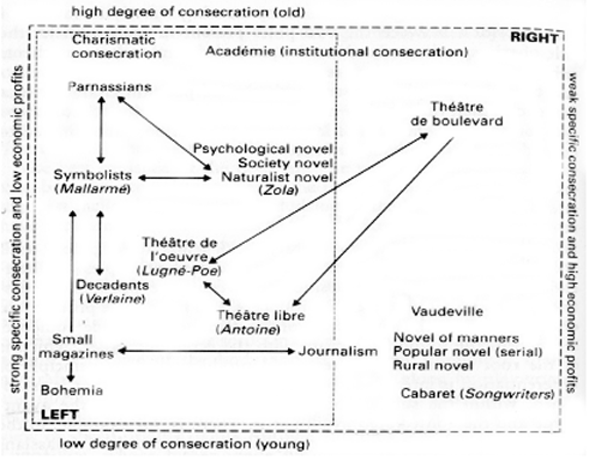
On Wednesday the 10th November I attended a lecture given by Andrew Milner, Professor of Cultural Studies at Monash University, Melbourne in the Cypress building of the University of Liverpool. Although entitled 'from Flaubert to the Fantastique' the lecture was actually mostly about French sociologist, Pierre Bourdieu, and specifically his Les Règles de l'art. In Les Règles de l'art was a map which charted the positions of all of the current art of France giving it a relative location to all other forms of contemporary art. From left to right the items on the map increased in their profitibility and decreased in their 'art for art's sake' philosophy, meanwhile their vertical position was determined by their level of consecration, or how institutionalised they were. Here's an English translation of Bourdieu's map, I couldn't find a French one (such as the one Prof. Milner used in his demonstration) on the interweb:


Professor Milner proceeded to explain the original diagram in far better detail than I have above, before unveiling his remodelled version based, not on the French arts contemporary to Bourdieu, but on Science Fiction. Other changes made were that Bourdieu limited his diagram to only living influences (such as Zola in the centre), whilst Professor Milner expanded his to include artistes who have passed on, but who remain a "living influence" such as Philip K. Dick and J.G. Ballard, amongst others. Similarly, Bourdieu's diagram restrains itself to France alone whilst Professor Milner's reflects the multinational nature of modern movement such as Science Fiction and is global in its scope.

Being unable to provide a picture of Professor Milner's revised map there is little else I can do in this blog post except to attempt to draw a rough sketch of it in your mind's eye. Prof. Milner's map retained the three rough divisions of Poetry, Literature and Theatre that Bourdieu creates (in that order as vertical columns for left to right), expanding Theatre to encompass TV, film and radio, and including sf criticism such as Darko Suvin in the poetry category both because it makes a similar amount of money, and because there is so little sf poetry with which to flesh out the diagram.
Commercial TV occupied the bottom right corner, being the most populist, "all about the money" form of sf, and Gene Roddenberry was singled out as the exemplar of this movement. Above it came mainstream (ie. Hollywood) cinema moving up the map towards art-house cinema by people like Andrey Tarkovskiy. On the bottom left, occupying the role of Bohemia, was Ballard and Moorcock and New Worlds magazine, above them (though slightly more to the right and centre) was weird fiction as exemplified by China Miéville, before shooting back to the left (ie. the poor end) and the top with Darko Suvin-level critique. Zola's position as the dead centre of French culture was occupied by Wells and Verne and Scientific Romance. Below them were various sub-genres such as cyberpunk moving down to the pulps and championed by Hugo Gernsback. Above Wells and Verne were the American Feminist and Afrofuturist writers such as Le Guin and Delany with the top echelon of the novel being occupied by "literary" sf such as Orwell, Huxley et al.. A dotted line was drawn around literary sf, Darko Suvin and arthouse cinema which Professor Milner explained was a permeable barrier between sf and wider cultural movements. The things within the dashed line had crossed the barrier and been appropriated by wider society and thus no longer seen as sf by said community - or at least not tarred with the same brush - the nature of this barrier was interesting however, as Prof. Milner explained its one-way permeability as the sf community still involve it in their discussion and ideology, whilst mainstream communities prefer to ostracise it.

Overall it was an interesting lecture which felt much more like a "just throwing this out there" kind of a affair than the turgid affair genre theory can devolve into. I thought that Professor Milner's adoption and adaptation of Bourdieu's method of mapping had real potential as a method of thinking about the relationships of different forms of sf and their relationships with the social spheres of which they are a part. Of course the positioning of some of the elements is arguable, it's all based on conceptual ideas rather than formal numerical data, and some ideas could be expanded in a larger diagram but you have to stop somewhere or you could draw a map the size of the Liver Building and still be missing some of the details. One item, or possibly two, that I thought should have been on there but weren't were video games (which could possible be split up into commercial and indie) as they are valid narrative vehicles which can still be plotted on the map relative to the other items mentioned.

This is, however, a detail which doesn't detract from the usefulness of the model and I look forward to reading the full article in a forthcoming edition of Science Fiction Studies. One interesting exercise would be to overlay the map with another for Fantasy and Horror as they occupy similar spaces in the wider literary community, but their sub-genres and movements have as varied a relationship as sf.

7 November 2010

Stories from The Mammoth Book of Alternate Histories #6

Here are some thoughts on the final three stories in The Mammoth Book of Alternate Histories. What was going to follow was a complete review of the volume as a whole but I've written that up for the journal Foundation instead and so can't post it up here, you'll just have to buy the journal instead. It's also part of the reason why this is going up so late (that and Twisted Tales). If summaries are even less comprehensive than normal the please forgive me, it's been a while.

"The Sleeping Serpent" by Pamela Sargent, pp. 472-513.

An interesting story because it approaches a historical divergence less commonly displayed than others. Sargent posits a global Khan, a Mongol Empire that stretched from Western Europe to Eastern North America. Some of the last unconquered peoples are the "Inglistani" and, crucially, the Native American tribes of the American North-East. In an attempt to rid North America of the Inglistani, and to give them nowhere to seek refuge once the European Khans take Britain, a force of Mongols and Native Americans wage war on the colonial settlements. Sargent draws on a lot of the imagery and tone of the Leatherstocking Tales in suggesting a Mongol protagonist who as a child was adopted by "The People of the Long Houses" (The Iroquois Federation) as one of their own and raised in their culture. This allows Sargent to present an interesting comparison between the typically represented "pure" and "noble" Iroquois peoples and the Mongols, once similarly nomadic and spiritual but now corrupted by power, greed, and the wealth of conquered Europe. I always feel like these stories idealised Native American lifestyles and philosophies, and yet I also enjoy the aesthetic of such approaches (The Last of the Mohicans was one of my favourite reads from my Undergraduate reading lists). Maybe I'm wrong and life really was that rich and rewarding, after all I have no first hand experience and little second hand knowledge of Native Americans. It seems to me odd however that the Mongolians would only reach the epiphanies they reach in this story once they reach the Atlantic, they will have passed by, probably crushed, and expanded over many other tribes in the West of the continent such as the Californian tribes which are such an influence to Ursula Le Guin's fiction.

"Waiting of the Olympians" by Frederick Pohl, pp. 514-559.

I loved this story. It doesn't even do anything particularly amazing in itself, but a number of factors come together to make this story in particular stand out as something a little bit different to the other tales in the anthology. At first it seems we're being presented with a standard "What if the Roman Empire never fell?" proposition, however instantly making this story noteworthy is that the protagonist, Julius, is a "sci-rom" writer. Desperately in need of an idea for a new novel to fulfil his publishing contract, he travels to Alexandria where a conference is being held to discuss the Olympians, a [Culture-like] multi-race organisation, who have made first contact with Earth and are travelling on a years long journey to visit in person. Whilst in Egypt a friend of Julius's, and a scientific advisor to the Roman state on all matters Olympian, Flavius "Sam" Samuelus, suggests "a whole new kind of sci-rom" about an "alternate world" which plays host to the question "what if history had gone a different way?" I love the meta-alternate history elements of this story, even if they are simply a cover for Pohl to explain where his world deviated from ours (Christ was never crucified and so Christianity, lacking a martyr, lost momentum), although he does include some "Grasshopper Lies Heavy"-like supposition about a world alternate to theirs which still isn't ours. Overall, I enjoyed the science fiction and meta-narrative elements of this story and it made a nice complement to the others in the collection, not necessarily better but just different enough to be enjoyable.

"Darwin Anathema" by Stephen Baxter, pp. 560-582.

The Catholic church are easy targets for alternate history, as evidenced by Keith Roberts's Pavane. Not quite as easy as Nazis, but easy nonetheless. Baxter depicts a world held back technologically by the church,  where Terra Australis (Australia) is a world leader in scientific development (far from the gaze of the Vatican). This was one of the specially commisioned tales for the anthology and its likely that is was inspired by the recent flurry of media attention given to Charles Darwin for the 150th anniversary of the publication of his Origin of Species, as well as his 200th birthday. The story features humour and grisliness in equal amount as Darwin's bones are exorcised and put on trial for heretical thinking. "Commisary Hitler" makes a cameo reference for his "Missionary Wars" in Russia, whilst there is also a nice reference to H.G. Wells and a novel entitled "War of the Celestial Spheres", punning on The War of the Worlds and the old-church belief in celestial astronomy (Baxter also wrote, The Time Ships, the excellent authorised sequel to Wells's The Time Machine which involves the development of several alternate histories and futures). This is a superbly crafted story, as you'd expect from a man who has written as extensively in the alternate history field as Baxter has. Loaded with references and nods, it still manages to propel a story of human emotion and the problems of a lack of moral autonomy within religious structures. A brilliant story to round off a fantastic collection.


Here endeth the saga of Ian Watson and Ian Whates's The Mammoth Book of Alternate History. Below are  links to the other parts.

Part 1: "The Raft of the Titanic" by James Morrow, "Sidewinders" by Ken Macleod, "The Wadering Christian" by Eugene Byrne & Kim Newman, "Hush My Mouth" by Suzette Haden Elgin.

Part 2: "A Letter From The Pope" by Harry Harrison and Tom Shippey, "Such A Deal" by Esther M. Friesner, "Ink From The New Moon" by A. A. Attanasco.

Part 3: "Dispatches from the Revolution" by Pat Cadigan, "Catch that Zeppelin!" by Fritz Leiber, "A Very British History" by Paul McAuley, "The Imitation Game" by Rudy Rucker, "Weihnachtsabend" by Keith Roberts.

Part 4: "The Lucky Strike" by Kim Stanley Robinson, "His Powder'd Wig, His Crown of Thornes" by Marc Laidlaw, "Roncesvalles" by Judith Tarr, "The English Mutiny" by Ian R. Macleod, "O One" by Chris Roberson.

Part 5: "Islands in the Sea" by Harry Turtledove, "Lenin in Odessa" by George Zebrowski, "The Einstein Gun" by Pierre Gévart, "Tales from the Venia Woods" by Robert Silverberg, "Manassas, Again" by Gregory Benford.

Part 6 [This Part]: "The Sleeping Serpent" by Pamela Sargent, "Waiting of the Olympians" by Frederick Pohl, "Darwin Anathema" by Stephen Baxter.

2 November 2010

Frantic Week

Wa-ay behind with my blogging duties. To be fair though, I've had a mad old time of it. Right now I'm writing this off the back of a five day Halloween celebration. Burke and Hare on Thursday, Twisted Tales #1 on Friday, a party on Saturday, a lantern parade in Sefton Park on Sunday, and my science fiction/ fantasy book club's reading of Bradbury's Something Wicked This Way Comes today.

I'll be posting those comments on the last few stories in The Mammoth Book of Alternate Histories soon. In the meantime, take a wander over to the newly launched Twisted Tales website and support Horror fiction events!

24 October 2010

China Miéville versus Facebook

Posted without comment via Hannu Rajaniemi via the M.John Harrison blog.

Facebook
1601 S. California Avenue
Palo Alto
CA 94304
USA
6 October 2010

Dear Facebook People,

URGENT COMPLAINT– PLEASE READ, MORE ACTION TO FOLLOW SHORTLY

1) The short version:
At least one person, if not more, is/are impersonating me on Facebook, with (a) fake profile(s) claiming my identity. Despite me repeatedly bringing this to your attention, you have taken no action to remedy the situation. And I’m getting very annoyed.

2) The full version:
This thing you hold is called a letter. This is the third time I’ve contacted you, and I’m doing so by this antiquated method because, and I realise this may shock you so brace yourself, I have no Facebook account. Which means it is nigh-on impossible for me to get in touch with you. Kudos for your Ninja avoidance strategies.

Back when you had a button allowing me to alert you to a fake profile despite not having an account myself, I contacted you that way. I was answered with a resonant silence. Subsequently, when the problem persisted, I hunted lengthily for, found and left a message on the phone number you go out of your way to hide. Absolutely nothing happened. So here we go again: third time’s a charm.

I am being imitated on Facebook. I believe the only reason anyone is bothering to do this is because I’m a novelist (published by Macmillan and Random House), a writer and broadcaster, with a minor public profile. I think there are one or two community pages about my stuff on Facebook – that of course is very flattering and nice of people to bother. The problem is that there is or are also pages by someone(s) purporting to be me. This is weird and creepy. What’s worse is I know for a fact that some readers, friends and colleagues are friending ‘China Miéville’ under the impression that it is me, and that others are wondering why ‘China Miéville’ refuses to respond to them. And I have no idea what dreadful things or ‘likes’ or ‘dislikes’ are being claimed as mine, nor what ‘I’ am saying.

I know lots of people enjoy being on Facebook. Great. More power to them. Vaya con Dios. Me, though: not my thing. I have absolutely no interest in it. I am not now nor have I ever been a Facebook member. Short of some weird Damascene moment, I will not ever join Facebook – and if that unlikely event occurs, I promise I’ll tell you immediately. In the meantime, though, as a matter of urgency, as a matter of courtesy, as a matter of decency, please respond to my repeated requests:

• Please delete all profiles claiming to be me (with or without the accent on the ‘é’ – last time I looked, I found one ‘China Mieville’, and one more accurately rendered).

• Please do not allow anyone else to impersonate me. I have neither time nor inclination to trawl your listings regularly to see if another bizarre liar has sprung up.

• And while you’re at it, please institute a system whereby those of us with the temerity not to sign up to your service can still contact you on these matters and actually get a [insert cuss-word] answer.

I appeal to you to honour your commitments to security and integrity. Of course as a multi-gajillion-dollar company I have absolutely no meaningful leverage over you at all. If David Fincher’s film doesn’t embarrass you, you’re hardly going to notice the plaintive whining of a geek like me. All I can do is go public. Which is my next plan.

I’m allowing a week for this letter to reach you by airmail, then three days for you to respond to me by phone or the email address provided. Then, if I’ve heard nothing, on 16 October 2010, I’ll send copies of this message to all the literary organizations and publications with which I have connections
some of the many books bloggers I know; and anyone else I can think of. I’ll encourage them all to publicise the matter. I’m tired of being impersonated, and I’m sick of you refusing to answer me.
I look forward to hearing from you.

Yours sincerely,

China Miéville

23 October 2010

Antony and Cleopatra @ The Playhouse

A slight detour from my normal posts which directly relate to my research, last night I went to Liverpool's Playhouse Theatre to watch their production of Shakespeare's Antony and Cleopatra, directed by Janet Suzman.

Kim Cattrall as Cleopatra revels in the humour of the early acts, portraying the Egyptian Queen as a carefree spirit, luxuriating in the banter of her court  (see the scenes with the eunuch singer) and with Antony. So obviously at home playing to the comic aspects I was initially worried that she wouldn't be able to support the weight of the heavier, darker material of the play's climax. Suzman is astute in her balancing of the mood however, as even in the turmoil and misery of the second half she picks out Shakespeare's black comedy. Rather than jar with the tone of the play, such an action prevents the second part feeling at odds with the, at times, whimsical first half. Complementing this directorial choice, Cattrall finds considerable acting chops during the interval and the Cleopatra who emerges wearing a breastplate (albeit all too briefly), and rouses the armies of Egypt, is a Cleopatra who is believable in her grief and ultimately in her death.

Kim Catrall and Jeffery Kissoon, (c) Stephen Vaughan
Meanwhile, Jeffery Kissoon is a bubbling frenzy of a Mark Antony, frothing and flailing in his grief and anger, swaggering and magnanimous in his glory and his revelling. As the play opens we find him drunk and asleep at the foot of Cleopatra's lounger, his ample belly rising and falling as he snores in his sleep. Armed with a hip flask and a sword this is Antony the party animal, the man who has found love and a rich life in a distant land, who is willing to burn everything he once new for a new life. Kissoon plays hi part with passion and vim, presenting Antony as a man who's an old man playing the young man's games of war and partying, but still holding his own until the play's finale when he crumbles under the strain exploding in fits of rage and tears.

Another stand out performance has to be Martin Hutson as Octavius Caesar, the man who will become Augustus - the first Emperor of Rome. Hutson captures Caesar the political animal, something made clear when he first appears not in the military uniforms of his followers, but in a suit. This Caesar is meticulous, almost anal, in everything he does, constantly conscious that (a bit of meta-theatrical irony for you) he's playing a role, careful not to let normal soldiers see him weep for Mark Antony, or loose control after having a drink. Whether by direction, or Hutson's talent (or, more likely a blend of the two), Octavius Caesar in this production is exactly the smooth-operating, verging on slimy, character that history shows him to be.

The set is a marvellous contrivance of shining black and burnished gold. Brick and metal and glass. Stylish and more than fit for purpose, it blends a modern industrial edge (large girders sprout from the far right and left of the stage, with a gangway providing the top edge of a frame within a frame)  with Eastern mystique (ornate lamps hang down in Cleopatra's palace with drapes and upholstery to match the black and gold set. Similarly blended are the costumes that the character's wear: the soldiers wear modern stab vests and wield automatic rifles, whilst also wearing breastplates, similarly Cleopatra wears believable robes as well as black frame glasses and stiletto heels. Such juxtapositions remind us of the timeless nature of Shakespeare's material, channelling the ancient, with the modern through the early 17th century, but Suzman also uses the costumes to another effect. At the beginning of the play Cleopatra and her attendants are wearing white and are carefree and laughing, but by the end they wear the black of funeral mourners; mirroring this, Caesar wears a dark suit and his men are in black dress uniforms, but by the time they enter Cleopatra's monument they're wearing polished breastplates which reflect the stage lights like mirrors - effectively representing Cleopatra's waning glory as Caesar ascends to become the brighter star which eclipses her, just as Rome would come to eclipse Egypt.

Overall, it was an enjoyable play that still managed to find a few surprises in a story well known and often retold (and I don't mean the casting of a man, Mark Sutherland, as Caesar's sister Octavia). A highly recommended viewing for anyone that has the time to go and see it before its run ends on the not too distant 12th November.

14 October 2010

Stories from The Mammoth Book of Alternate Histories #5

Back again for another installment of stories from The Mammoth Book of Alternate Histories. Only one more after this (3 more stories), then I'll be passing on my thoughts on the book as a whole. But until then:

"Islands in the Sea" by Harry Turtledove, pp. 374-401.

The blurb of The Mammoth Book picks out this story by Turtledove as one of it's highlights, briefly synopsising it as "only pockets of Christianity remain in an Islamic Europe". This, I feel, is slightly misleading. True, Constantinople has fallen to the Arabs (in the 700s), but the story points out that Christianity survives in Italy, modern day France, Britain and Ireland, and likely a few other places as well. This is a rather large pocket, and making up a reasonable amount of Europe. But that's nitpicking with the description on the cover, not with the story the plot of which revolves around Islamic and Christian envoys travelling to Bulgaria and vying to convert the Khan to their religion. The consequences are spelt out as being the fate of Europe - if the Khan goes Christian there's hope of one day retaking Constantinople and securing Europe for Christianity, whilst if he converts to Islam then it would create a bottleneck, hemming Christianity into the North and West of Europe and dooming it to eventual extinction. By presenting the two alternatives as equally possible, Turtledove offers the reader two alternatives within his alternate history. History could possibly be put back on the rails we recognise in a deus ex machina manner (as in Roth's The Plot Against America), or it could get even more alternate (closer to the description in the blurb!). The scenario also allows Turtledove to explore Christian and Muslim philosophies, playing them off against each other - exposing the similarities and ludicrousness of each faith as viewed by the other. In this way reminding us of the connection the two religions share and the pointlessness of conflicts between them. The Khan's final remarks serve to remind us of the knife edge of history as he suggests what might have been (In our timeline, the Danubian Bulgars converted to Christianity in 865).

"Lenin in Odessa" by George Zebrowski, p. 402-421.
The first twist in this tale comes on page 404, at the beginning of part 2, where our narrator is referred to by Lenin as "Comrade Stalin". This is another of those stories which lives in the moment, it relates the change in the timeline without dwelling on the consequences, indeed there are even less hints than normal about what new world this story has created. Lenin is assassinated in 1918 in Odessa by a man called Sidney Riley, allowing Stalin to take control four years earlier than he would have. If you're history was uncertain it would be very easy to read this as a piece of historical fiction, rather than a-historical; Lenin did suffer attempts on his life in 1918, and Zebrowski does a good job of giving a voice to the unknowable Stalin (I say unknowable remembering a quote from the author Robert Harris: 'Between these two events... there lies - what? Who? We do not know. And why? Because Stalin made it his business to murder almost everyone who might have been in a position to tell us what he was like ...' Archangel, p. 70.). I could wish for more of the after effects, but then I've always wondered what happens after Dr. Strangelove ends...

"The Einstein Gun" by Pierre Gévart, pp. 422-436.

A brilliant story first translated into English from the original French especially for this collection by Sissy Pantelis and Ian Watson. It's conceit puts me in mind of Ward Moore's Bring the Jubilee - we start the story in an alternate world and the protagonist through the manipulation of time creates our reality, making us the alternate. It's a neat inversion which though now familiar is well implemented here. Where Bring the Jubilee begins in a world where the Confederates won the American Civil War, The Einstein Gun commences in a reality where Gavrilo Princip's assassination attempt on the Archduke Franz Ferdinand fails and World War I never happens. Despite avoiding the First World War, this reality seems destined for major turmoil. Hitler still comes to power, this time as Chancellor of the Austro-Hungarian Empire under Emperor Franz Ferdinand, and he pursues the same racist and radical paths which he follows in our own time, targeting Slavs and Jews. Our narrator Otto, with the held of Albert Einstein who ultimately, in an ironic twist, is forced to shelter from Hitler's fascism in Germany, send a gun back in time to replace Princip's (the failure of the gun being revealed as the reason why the assassination failed). The story is of particular interest to me as it suggests a certain inevitability to many of the events of the twentieth century leading the reader to draw the conclusion that either Hitler is innately evil and pollutes the entire century regardless of the events around him, or that the problems of the Second World War are deeper rooted than we might expect, stretching beyond the First World War and to the broken and unfair systems of Imperialism and Nationalism and to the deep seated racism of Europe at that time.

"Tales from the Venia Woods" by Robert Silverberg, pp. 437-456.

Theres a fairy tale feel to this story of a cabin the woods. It's a 'Rome didn't fall' altnerate history which suggests a Rome which rules for a thousand years longer than it did in our time, before beginning a Second Republic and killing the Emperor and all of his kin (in a manner which reminded me of the Romanovs in the Russian Revolution, possibly a deliberate move by Silverberg given the Tsarist family's surname). Two Teutonic children discover a hunting lodge in the forest and an old man who lives there who turns out to be the last surviving Caesar, a brother of the last Emperor. The story sits as part of Silverbergs' Roma Eterna, and maybe it's because I knew this that I didn't find the story went anywhere in particular by itself. We are already in an alternate world, with no indication of how it became the way it did (that comes in an earlier Roma Eterna story) and thus cannot really relate to the implications of Second Republic versus Imperial that seem to be presented here - even relating them to their earlier equivalents in the Roman Empire we know now is of little use given the thousand year discrepancy. I've yet to read the other stories in the Roma Eterna series (though they are on my to-do-list), but I'm sure this could not have been the most suitable for this collection.

"Manassas, Again" by Gregory Benford, pp. 457-471.

Another 'Rome didn't fall' story, but this one couldn't be much more different. This is military sf in every sense, a futuristic feeling tale of a world where the Romans developed a steam driven machine gun, courtesy of Sygnius of Albion, and went on to dominate the world with their advanced technology. By the time of this story the humans who live in now independent American colonies are fighting against robotic rebels in "the first battle of the first war in over a century". Manassas, Virginia, was the the site of the first major land battle of the American Civil War in our continuity and so it's choice in this story is heavily loaded to American readerships. As it is, the use of Manassas creates a sense of echoing - certain events happening ,in different ways, but happening nonetheless throughout realities. Part of it could be down to fate, or simply a sense of inevitability, but many alternate histories do it - even within these that I've looked at in this post, and it's an interesting phenomenon. Despite change, history repeats.